How to Cook Over Medium Eggs (Perfect Soft Yolk Guide)
Struggling to cook over medium eggs? Learn how to make them with the perfect soft yolk using simple steps, timing, and heat control.
In this article▾
- Quick Answer: What Are Over Medium Eggs?
- What Does "Over Medium Eggs" Mean?
- What Do Over Medium Eggs Look Like?
- Types of Fried Eggs (Quick Guide)
- Over Easy vs Over Medium vs Over Hard
- How to Cook Over Medium Eggs
- Over Medium Eggs Time and Heat Control
- Why Over Medium Eggs Are Hard to Get Right
- How to Know When Your Egg Is Perfect
- Common Mistakes and How to Fix Them
- Over Medium vs Jammy Eggs
- Factors That Affect How Over Medium Eggs Turn Out
- Are Over Medium Eggs Safe to Eat?
- Nutrition of Over Medium Eggs
- Conclusion
Cooking over medium eggs sounds simple, but it often goes wrong. You flip the egg, and the yolk breaks. Or the yolk turns too runny or too firm. Small timing mistakes can completely change the result.
That's because over medium eggs sit right in the middle. They are harder to control than over easy or over hard eggs. In this guide, you will learn exactly what over medium eggs are, how they should look, and how to cook them the right way every time.
Quick Answer: What Are Over Medium Eggs?
Over medium eggs are fried eggs cooked on both sides. The whites are fully set, and the yolk is soft but not fully runny.
This means the yolk is thick and slightly soft inside, not liquid like over easy eggs and not firm like over hard eggs.
What Does "Over Medium Eggs" Mean?
The word "over" means the egg is flipped during cooking.
The word "medium" describes the yolk. It is not runny like over easy eggs. It is also not fully firm like over hard eggs.
Instead, the yolk is soft and slightly thick inside. This gives a balance between a runny and fully cooked yolk.
What Do Over Medium Eggs Look Like?
Over medium eggs have fully cooked whites. There should be no clear or raw parts.
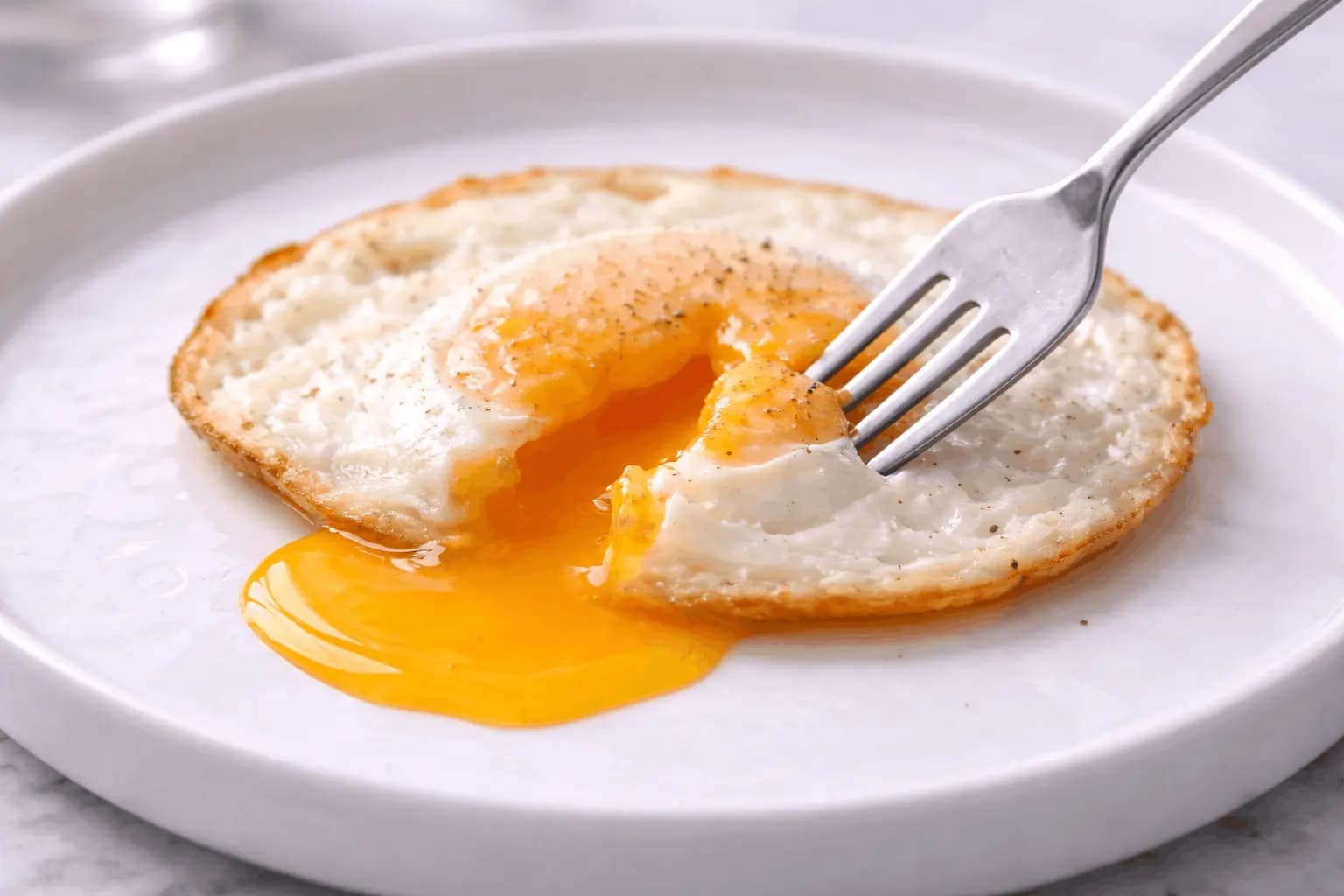
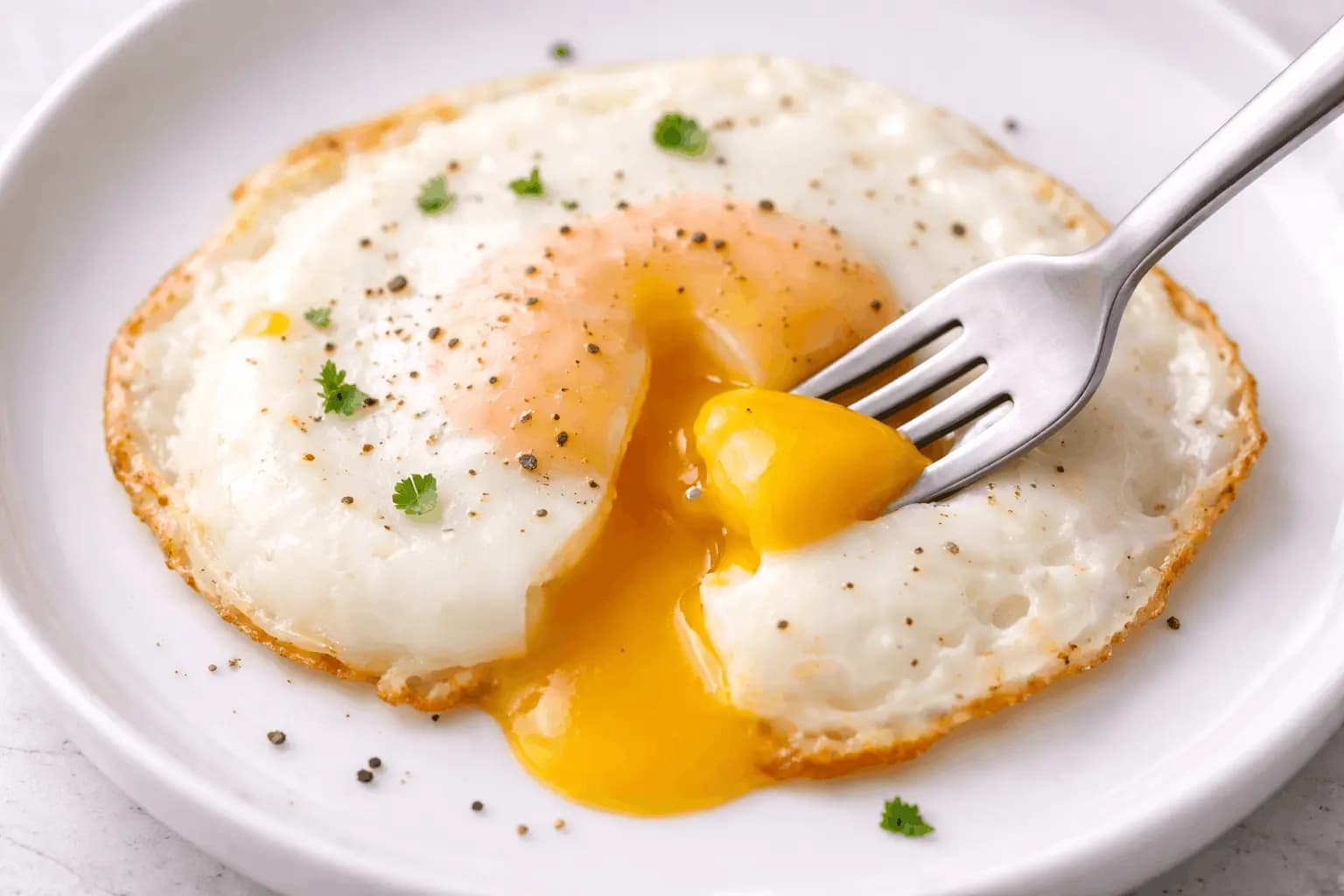
The yolk looks set on the outside. When you cut it, it should be soft and slightly thick. It may flow a little, but it should not spill like liquid.
Think of the yolk like warm custard or thick honey. If it spreads quickly like liquid, it is undercooked. If it does not move at all, it is overcooked.
Doneness Guide
| Doneness | What You See | What It Means |
|---|---|---|
| Too runny | Yolk spreads quickly | Undercooked |
| Over medium | Thick, slightly flowing | Perfect |
| Too firm | Yolk does not move | Overcooked |
Types of Fried Eggs (Quick Guide)
There are four main types of fried eggs:
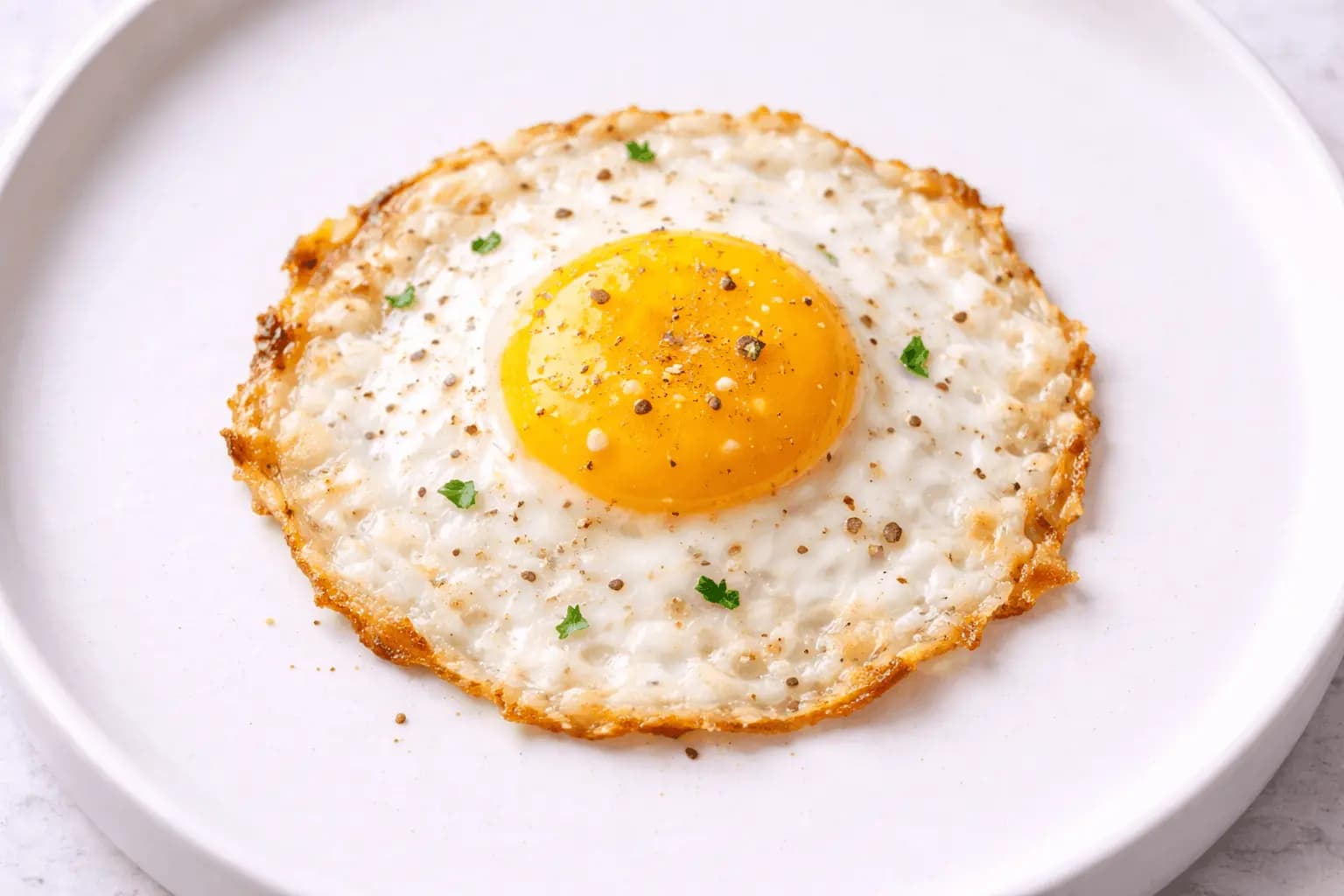
- Sunny side up – cooked on one side, yolk fully runny
- Over easy – flipped, yolk very runny
- Over medium – flipped, yolk soft and slightly thick
- Over hard – flipped, yolk fully cooked and firm
Each style depends on how long you cook the egg. Small changes in time can change the yolk completely.
Over Easy vs Over Medium vs Over Hard
| Style | Flip | Egg White | Yolk Texture |
|---|---|---|---|
| Over easy | Yes | Fully set | Runny |
| Over medium | Yes | Fully set | Soft and slightly thick |
| Over hard | Yes | Fully set | Fully firm |
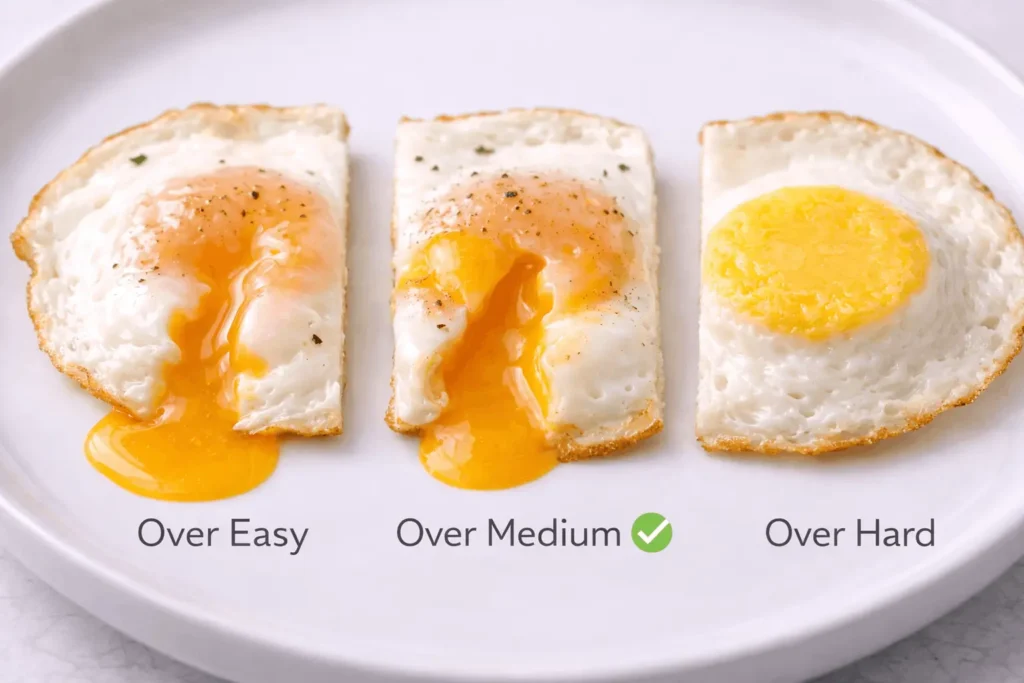
Over easy (left): runny liquid yolk. Over medium (center): soft, thick yolk—the perfect balance. Over hard (right): fully firm yolk. Small timing changes create big differences.
Over medium eggs sit right in the middle. They give you a soft yolk without being too runny.
If you want a thicker yolk that still has some softness, over medium eggs are the best choice.
How to Cook Over Medium Eggs
Follow these simple steps to get perfect over medium eggs.
Heat the pan
Place a non-stick frying pan on medium heat. Let it warm for about 1–2 minutes. A properly heated pan helps the egg cook evenly.
Add butter or oil
Add a small amount of butter or oil. Let it melt and coat the pan. Butter adds flavor, while oil handles heat better and is less likely to burn.
Crack the egg
Crack the egg into the pan gently. Keep the yolk whole. If the egg spreads too much, the pan may not be hot enough.
Cook the first side
Cook for about 2–3 minutes. The egg white should turn solid and white.
Flip gently
Use a thin spatula to flip the egg carefully. Do this only when the whites are fully set. If you flip too early, the yolk may break.
Finish cooking
Cook the second side for about 1–2 minutes. This gives the yolk a soft center. This timing will give you a soft yolk consistently.
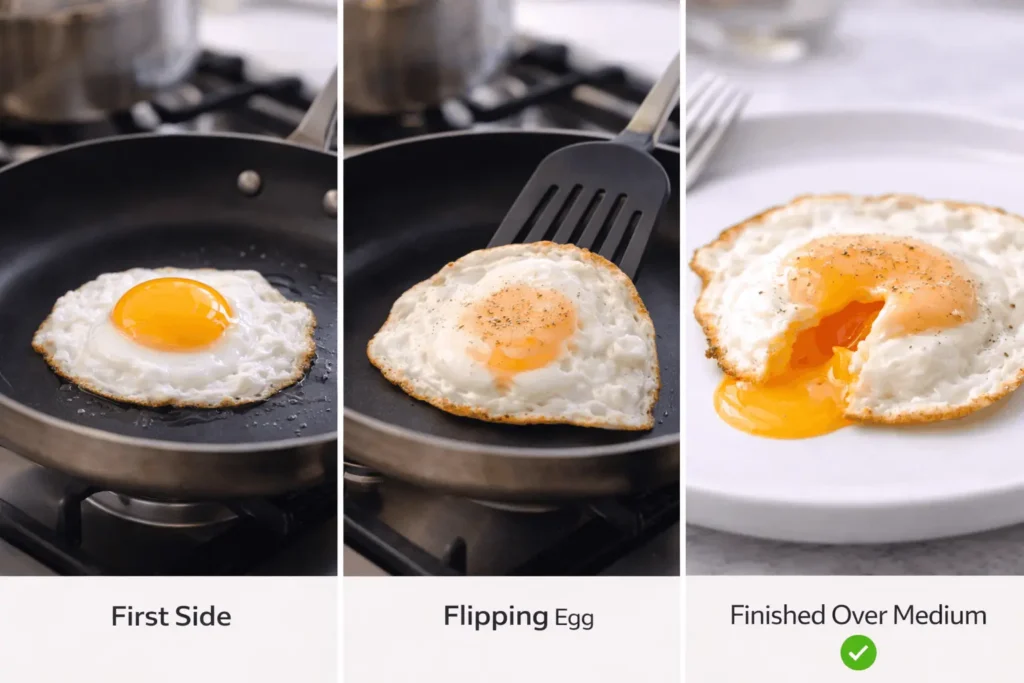
The process: Cook first side 2-3 minutes until whites set, flip gently with spatula, cook second side 1-2 minutes for soft thick yolk. The flip is key.
Quick Cooking Cheat Sheet
| Step | What to Do | Time |
|---|---|---|
| Heat pan | Medium heat | 1–2 min |
| First side | Cook until whites set | 2–3 min |
| Flip | Gently turn egg | — |
| Second side | Cook for soft yolk | 1–2 min |
Over Medium Eggs Time and Heat Control
Timing and heat are very important.
- First side: about 2–3 minutes
- Second side: about 1–2 minutes
Use medium heat, not high heat.
If the heat is too high, the egg can cook too fast. This can make the whites rubbery and the yolk too firm.
If the heat is too low, the egg may spread and cook unevenly.
Egg size and starting temperature also matter. Cold eggs from the fridge take longer to cook. Room temperature eggs cook more evenly.
If your egg is too runny, cook the second side for 20–30 seconds more. If it turns too firm, reduce the cooking time slightly next time.
Why Over Medium Eggs Are Hard to Get Right
Over medium eggs have a small cooking window. That is why many people struggle with them.
If you cook them for too little time, the yolk stays too runny. If you cook them too long, the yolk becomes firm.
Flipping also adds difficulty. A gentle flip is needed to keep the yolk intact.
Because of this, control over heat and timing is key. Even small changes can affect the final result.
How to Know When Your Egg Is Perfect
Do not rely only on time. Look for clear signs.
- The whites are fully set and not clear
- The edges look firm but not crispy
- The yolk feels slightly soft when touched gently
If the yolk feels too soft, cook it for 20–30 seconds more. If it feels too firm, reduce cooking time next time.
When you cut the egg, the yolk should be thick and soft, not watery. This is the best indicator of a perfect over medium egg.
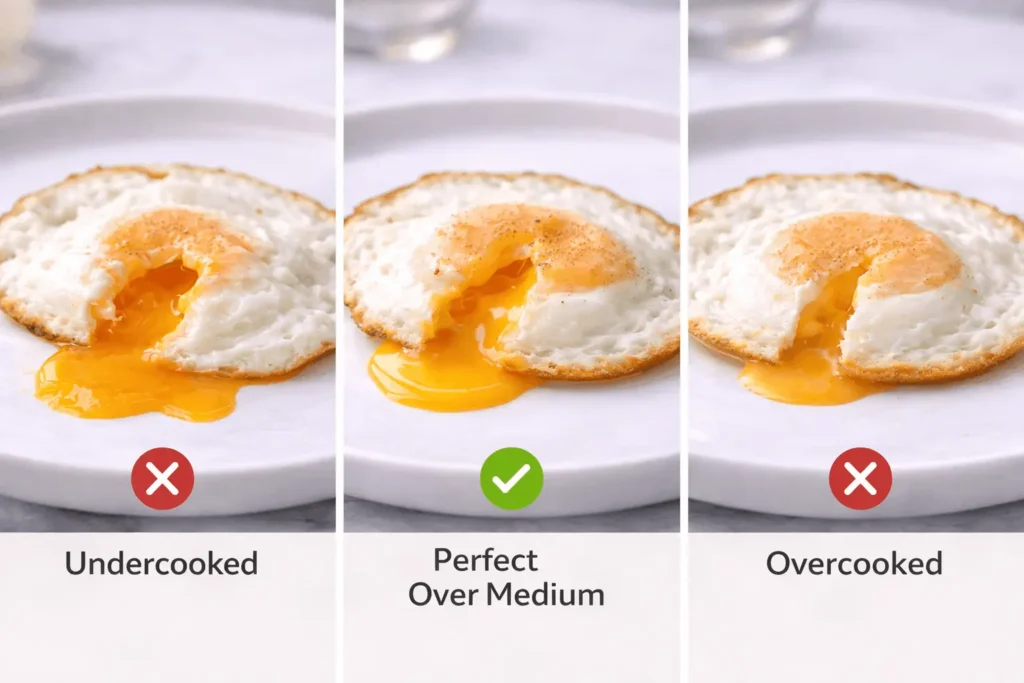
Too runny (left): yolk spreads like liquid—undercooked. Perfect (center): thick, slightly flowing like custard—just right. Too firm (right): yolk doesn't move—overcooked.
Common Mistakes and How to Fix Them
Yolk breaks while flipping
Flip only after the whites are fully set. Use a gentle motion with a spatula.
Egg is too runny
Cook the second side a bit longer, about 30 seconds more.
Egg is too firm
Reduce cooking time slightly on the second side.
Egg is rubbery
The heat is too high. Lower the heat and cook more slowly.
Egg sticks to the pan
Use enough oil or butter. Also, make sure the pan is properly heated before adding the egg.
Quick Fix Guide
- Yolk too runny → cook 20–30 seconds more
- Yolk too firm → reduce cooking time
- Egg sticks → add more oil or heat pan properly
- Yolk breaks → flip later and more gently
Over Medium vs Jammy Eggs
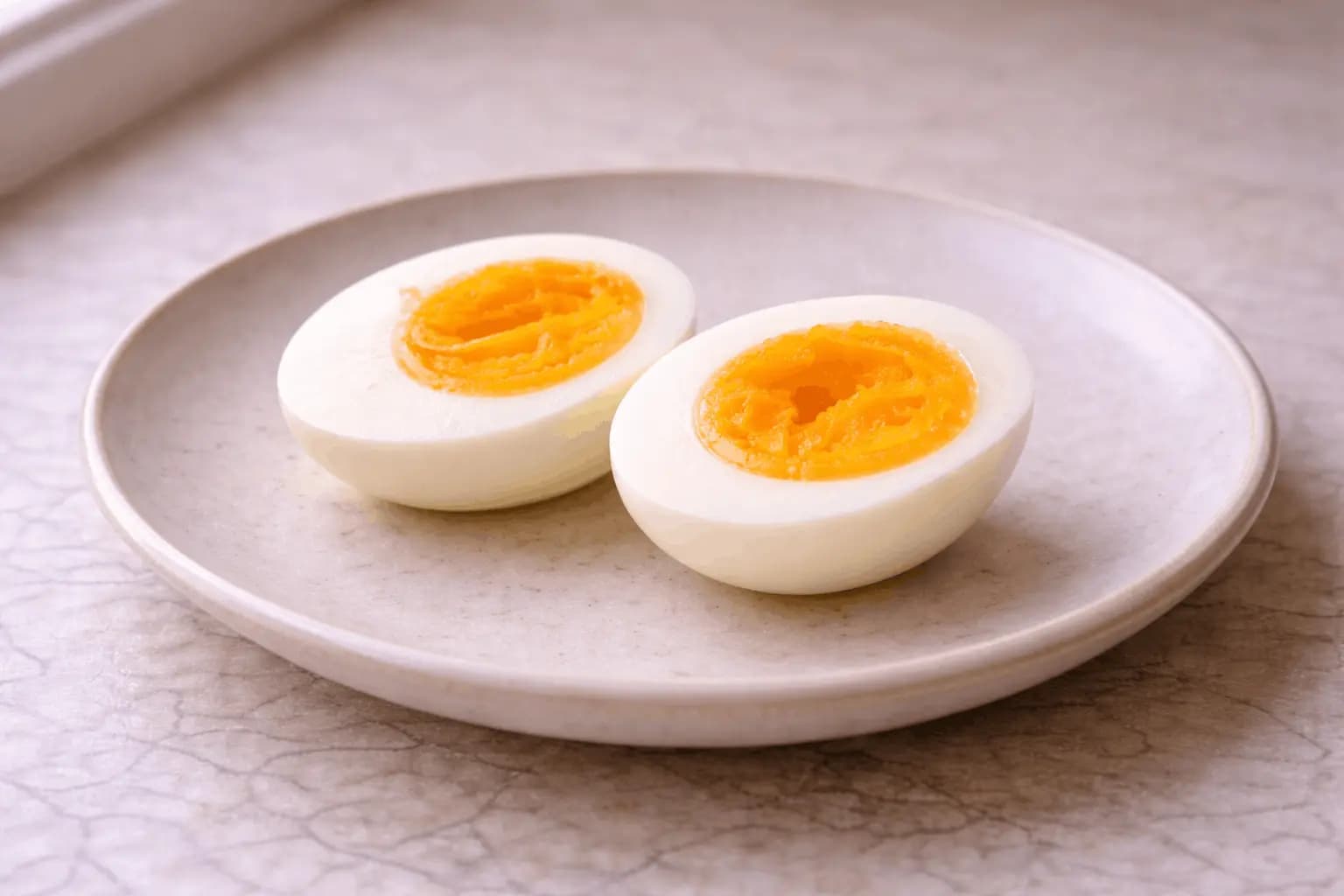
Over medium eggs are fried, while jammy eggs are boiled.
- Over medium eggs have a soft yolk from frying
- Jammy eggs have a thick, gel-like yolk from boiling
Both have a soft center, but the texture and cooking method are different. If you prefer a more controlled texture, you can learn how to make jammy eggs for another soft-yolk option.
Factors That Affect How Over Medium Eggs Turn Out
Egg size
Large eggs take slightly longer to cook than small eggs.
Egg temperature
Cold eggs cook slower. Letting eggs sit at room temperature for a few minutes can help even cooking.
Pan type
Non-stick pans are easier to use. Cast iron pans hold heat well but need more control.
Butter vs oil
Butter gives better flavor but can burn faster. Oil has a higher smoke point and is better for steady heat.
These small factors can change your results, even if you follow the same steps.
Are Over Medium Eggs Safe to Eat?
Over medium eggs have a slightly soft yolk. For most healthy adults, they are safe to eat.
However, some groups should be careful, such as:
- pregnant women
- older adults
- people with weak immune systems
Food safety guidelines often suggest fully cooked eggs for these groups to reduce risk. If unsure, it is best to follow proper egg safety and risks before eating undercooked eggs.
Nutrition of Over Medium Eggs
One large egg has:
- about 70 calories
- around 6 grams of protein
- healthy fats
Cooking style does not change nutrition much. However, added butter or oil can increase calories. You can also explore egg nutrition benefits to understand their role in a healthy diet.
Conclusion
Cooking over medium eggs sounds simple, but small mistakes can change the result. The key is to control heat, timing, and flipping so the whites cook fully while the yolk stays soft.
Once you understand how the egg behaves and what the yolk should feel like, it becomes much easier to get consistent results. With a little practice, you can cook over medium eggs just the way you like every time.
Frequently Asked Questions
Are over medium eggs runny?+
No. The yolk is soft but not fully runny.
How long should I cook over medium eggs?+
About 2–3 minutes on the first side and 1–2 minutes after flipping.
Can you make over medium eggs without flipping?+
Flipping is the standard method. However, you can cover the pan with a lid and use steam to cook the top slightly.
What is the difference between over easy and over medium?+
Over easy eggs have a runny yolk. Over medium eggs have a thicker, soft yolk.
The Eggpedia Editorial Team
Editorial
The Eggpedia editorial team researches, writes, and fact-checks every guide against public food-safety and nutrition sources (such as USDA and FDA guidance) to give you reliable, practical information about eggs. Our content is educational and is not a substitute for personalized medical or dietary advice.
Last updated April 20, 2026.